
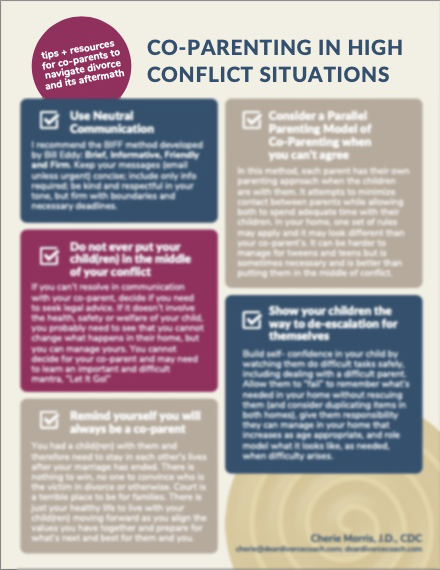
Co-Parenting in High Conflict Situations
Tips + Resources for Co-Parents to Navigate Divorce and Its Aftermath.
Most co-parenting advice assumes two people who both want it to work. When that is not your situation, the advice does not simply fail. It leaves you feeling like the difficult one.
What high conflict actually looks like
It is not the same as a painful divorce. Plenty of decent people divorce badly for a year and then settle into something workable. High conflict has a different signature. Agreements you thought were settled reopen. Handoffs turn into negotiations. You find yourself drafting a message about a dentist appointment four times, because you know it may end up in front of a judge.
If you have started writing to your co-parent the way a lawyer writes, that is not you being difficult. It is what experience has taught you.
You cannot negotiate your way to a cooperative co-parent
This is the most useful thing I tell clients and the least welcome. Cooperation is a two-person achievement. No amount of reasonableness on your side will produce it on theirs, and the years people spend trying are years their children are living through.
What you do control is real, though it is narrower than you want. Your response and its timing. What gets documented. What your children hear and are asked to carry. Whether a provocation gets a reaction or a receipt.
Parallel parenting is not a failure
When co-parenting asks for a level of cooperation that is not available, parallel parenting is the structure that works instead. Two households run largely independently. Communication kept to logistics, in writing, on one channel. A parenting plan detailed enough that ordinary weeks require no negotiation at all.
Parents often resist this because it sounds like giving up on the friendly version. In practice it lowers the temperature enough that some families find their way back to something warmer later. The specificity is the point. Every ambiguity in a plan is an argument waiting to happen.
Write as though it will be read aloud
Brief, informative, friendly, firm. No history, no defending yourself, no responding to the part designed to provoke you. One topic per message. If you would not want it read out in a courtroom, it is not ready to send.
Boring is a strategy. It is the hardest one to sell and the one that changes the most cases.
What your children actually need
Children do not need to be protected from the knowledge that their parents disagree. They need to be kept out of the middle of it. That means no messenger duty, no adult information framed as honesty, and no situation that quietly asks them to choose. A child who feels free to love both parents is doing better than a child with a perfect schedule.
When it is worth getting help
If the same argument has run three times with three different subject lines, the problem is the pattern rather than the topic. That is the point at which a coach earns their keep. Some situations also call for a therapist, a lawyer, or a financial professional, and I will say so when that is what I think.
The guide: Co-Parenting in High Conflict Situations
A free PDF covering communication that does not escalate, parallel parenting, and keeping children out of the middle. Yours to keep.
I am Cherie Morris, J.D., a CDC® Certified Divorce Coach and an instructor in the CDC® High Conflict Divorce Coaching certification program. I work often with the couple, and sometimes just the individual, to support the whole family system.